
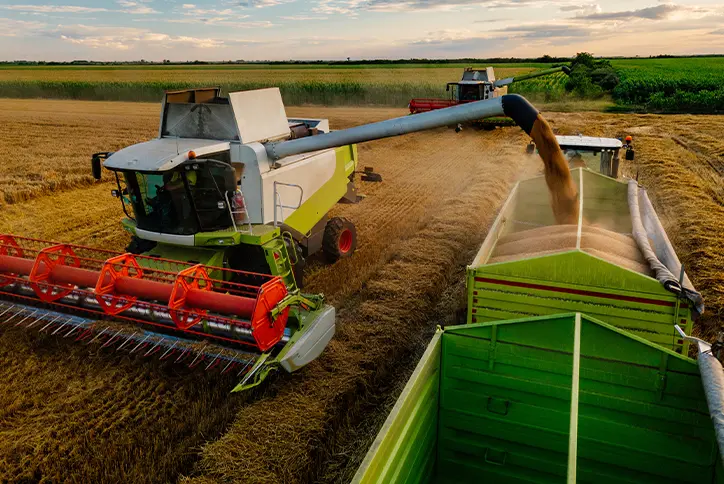
Formed sheet metal parts are ubiquitous components in agricultural equipment and applications. Nonetheless, these applications depend on formed components that must hold tolerance under vibration, impact, and exposure to moisture, dust, and chemicals. Guards, shields, brackets, covers, chutes, supports, and other components need accurate hole patterns, repeatable mounting points, clean edges, and consistent profiles to assemble correctly and perform in the field. Sheet metal laser cutting is often a preferred method for achieving these goals.
How a Fiber Optic Laser Works
There are different types of lasers, but fiber lasers are known for producing a tightly focused beam and high cutting precision. These lasers use optical fiber doped with rare-earth elements as an amplification medium. Light from diode sources is amplified in the fiber and directed onto the metal surface, where it melts or vaporizes the material, creating a narrow kerf (the gap from the removed metal). A gas jet removes molten material from the cut, leaving a cleaner edge.
Sheet Metal Laser Cutting Delivers Enhanced Precision and Accuracy
Precision and accuracy can impact assembly, functionality, and the longevity of agricultural parts. For example, misaligned or incorrectly sized holes can slow assembly, requiring rework or loosening in service. Brackets and structural supports require consistent geometry to transfer loads as designed. Small dimensional errors can shift loads onto fasteners or welds, increasing fatigue. Rough edges or heat-affected zones are more prone to corrosion or cracking, especially where coatings are thin or damaged.
Repeatability is also critical because it impacts replacement parts and maintenance. Replacement parts must match the original assembly without adjustment, particularly for agricultural equipment, which is often serviced in the field. When hole patterns and geometry are consistent, replacements become easier, avoiding extensive downtime or field modifications.
Sheet metal laser cutting supports the precision and accuracy demanded by agricultural applications. Because a fiber laser uses an intense beam to produce a clean cut with a narrow kerf, it achieves tighter cut geometry, better edge definition, and more accurate hole and slot placement. The cleaner cut can reduce secondary finishing to remove burs and support more consistent welding, bending, and coating in later production steps. These improvements result in a more precise and reliable fit for sheet metal components, which is especially important for agricultural equipment that demands exact tolerances and consistent assembly.
The precision of the laser cutter not only aids in assembly but also minimizes material waste, leading to cost savings and more efficient resource use. Other benefits of sheet metal laser cutting include:
- Tight Tolerances – Fiber laser cutting machines maintain exceptionally tight tolerances, ensuring agricultural equipment components fit together precisely without requiring extra machining. This precision is vital for reliable assembly, durability, and optimal function during demanding farming operations.
- Consistent Quality – Fiber laser cutting delivers uniform quality across all parts, reducing the risk of assembly errors and minimizing the need for rework. For agricultural machinery, this consistency ensures every part performs as designed and supports longevity in harsh environments.
- Non-Contact Cutting – Fiber laser cutting does not require physical contact with the material, preserving the integrity of each cut. This is especially important for delicate or specialized agricultural components, as it helps maintain clean edges and exact dimensions.
- Less Material Stress – Because fiber lasers produce minimal heat-affected zones and mechanical stress, agricultural parts are less prone to warping or distortion. This reduces the likelihood of fatigue and failure, making parts more reliable for field use.
Laser Cutting Sheet Metal Allows Greater Flexibility
For companies in agriculture, build schedules can shift based on dealer orders and commodity conditions. Often, engineering changes occur close to production, and missed component deliveries can disrupt assembly. Fiber lasers allow manufacturers to make adjustments quickly if scheduling shifts.
Fiber lasers have shorter setup times than traditional cutting methods. For example, CO2 lasers require precise mirror alignment and beam path calibration. A longer setup can become a manufacturing constraint. Once a fiber laser is powered on and parameters are set, it can process jobs more quickly and with less downtime between pieces. This provides greater flexibility to the manufacturer for scheduling and increased throughput. So when more orders are released in a shorter timeframe, the shops’ cutting capacity can scale without creating a backlog that pushes out delivery dates.
Versatility in Material Handling Reduces Sourcing Complexity
Fiber lasers can cut a wide range of materials and thicknesses up to 1 inch. This makes the fiber laser a valuable tool for agricultural products. Agricultural equipment rarely uses a single material thickness across an assembly. A company may need a 14 gauge cover, ½ in load-bearing component, and a 1-in structural component. Without the versatility of the fiber laser, work would need to be split between vendors, tying lead time to the slowest shop, and increasing fit-up risk across parts. Components spanning light gauge to thick plate can be produced within a single supplier base, reducing reliance on multiple fabrication sources.
Environmental Benefits of Sheet Metal Laser Cutting
Many organizations set environmental objectives, and collaborating with a sheet metal manufacturer that uses fiber laser technology can help achieve these sustainability goals. This advanced technology offers several ecological advantages that align with responsible manufacturing practices.
- Energy Efficiency – Fiber lasers offer greater energy efficiency than CO2 lasers, thereby reducing the overall carbon footprint of the cutting process.
- Cleaner Cutting Process – The high precision of fiber laser cutting minimizes the need for additional finishing processes, such as deburring or grinding, resulting in reduced material waste and fewer emissions.
For High Precision with Fast Turns, Choose S&R
S&R is a practical choice for sheet-metal laser cutting when speed and high precision are required. With extensive experience cutting and forming a variety of metals up to 1 inch thick, we ensure that cut parts perform well in downstream bending, welding, and assembly. This is essential in agricultural applications, where part fit, durability, and lead time all affect production and uptime. If you need a shop that understands fabricated parts, not just cutting, contact S&R to discuss your next project.