
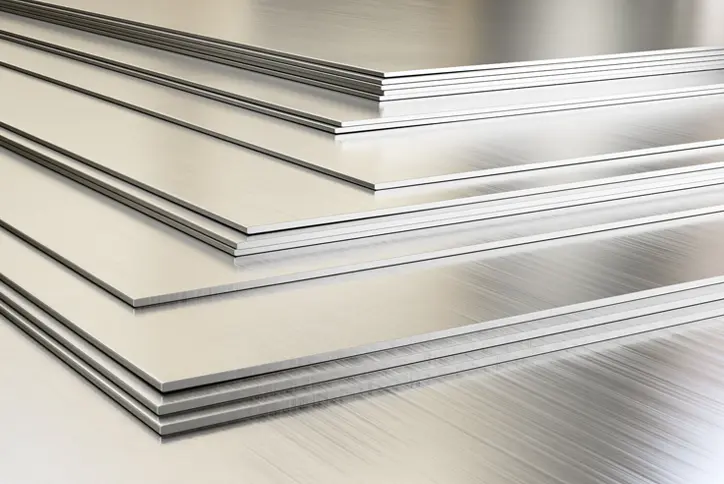
Material selection is one of the earliest decisions in sheet metal fabrication design and one of the hardest to correct later. Engineers are balancing structural requirements, manufacturability, cost, corrosion resistance, and downstream processes, such as welding, forming, and finishing. The right material choice reduces redesign cycles, controls costs, and improves part performance.
Functional Requirements in Sheet Metal Fabrication Design
Material selection starts with what the parts need to do and the environment they are exposed to. Key considerations include:
- Load conditions
- Exposure environment (weather, cycling temps, caustic materials, etc.)
- Required service life
- Whether it is cosmetic, structural, or both
- Compatibility with other materials
Consider the metal’s thickness as well. A design that works for thin gauge may fail or become unnecessarily expensive when scaled up to plate thickness. Engineers should confirm whether the design intent aligns with realistic forming, cutting, and welding constraints at the required thickness.
Metals Commonly Used in Sheet Metal Fabrication
Sheet metal fabrication relies on the unique characteristics of different metals to achieve specific design and performance goals. Understanding the commonly used metals and their properties is essential for selecting the right material for any application. Below are characteristics of commonly used metals.
Mild Steel
Mild steel, also known as low-carbon steel, typically contains 0.05% to 0.25% carbon. Mild steel is often selected for its strength, availability, and cost efficiency. It performs well in structural applications, frames, brackets, and assemblies where corrosion resistance is handled through coating or finishing.
From a design standpoint, mild steel offers predictable forming behavior and good weldability across a wide thickness range. Engineers should still account for bend radius requirements, potential distortion during welding on thicker sections, and post-fabrication finishing steps. Designs that ignore coating allowances or weld access may require rework.
Key Benefits:
- Relatively inexpensive
- Ductile, making it easy to bend and shape
- Good tensile strength and impact resistance
- High weldability with standard techniques
Stainless Steel
Stainless steel sheet metal contains at least 10.5% chromium and 1.2% carbon, along with other elements like titanium, nickel, silicon, nitrogen, molybdenum, and niobium. Various combinations produce different grades, each with distinct benefits.
Stainless steel is often chosen when corrosion resistance, hygiene, or appearance is critical. It behaves differently from mild steel during forming, particularly with sprinkback and work (or strain) hardening. These factors should be considered during design when determining bend allowances, flange lengths, and tolerances.
Designers should avoid overly tight tolerances unless functionally required. Stainless parts often require additional forming compensation or secondary operations, which can impact cost and lead time if not anticipated early.
Key characteristics
- Superior Corrosion resistance
- Good strength, hardness, and durability
- Easier to form and weld than mild steel
- Hygienic properties
- Pleasing aesthetics
Galvanized Steel
Galvanized steel is commonly used where corrosion resistance is needed without the cost of stainless steel. Engineers should consider how zinc coating affects welding, forming, and finishing. Excessive heat input can damage coatings, while tight bends may flake the zinc layer.
Realistic expectations are needed regarding the cosmetic appearance of joints. If aesthetics matters post-fabrication, finishing or alternative materials may be needed.
Key Characteristics
- Cost-effective corrosion due to zinc coating
- Low maintenance
- Durable and strong
Aluminum
Aluminum is often selected for weight reduction, non-magnetic properties, and thermal conductivity. There are several grades of aluminum of different chemical compositions, each having its own advantages. For example, series 1000 aluminum is 99 percent pure aluminum. It has excellent corrosion resistance but little structural value. Series 3000 has 1 percent manganese added, providing good corrosion resistance and good formability. Series 6000 contains manganese and silicon; these exhibit great strength and are often used in architectural applications.
Aluminum introduces challenges related to softness, galling during forming, and distortion during welding. Designs should minimize unnecessary complexity, avoid sharp internal corners, and consider reinforcement features when stiffness is required. Thickness selection directly affects forming limits and flatness after fabrication.
Key characteristics
- Lightweight
- Natural corrosion resistance
- Non-magnetic
- Non-sparking
- High thermal electrical conductivity
Compatibility With Other Materials In Sheet Metal Fabrication Design
Material selection cannot happen in isolation. Most sheet metal parts are welded, fastened, or assembled to dissimilar materials. Engineers need to consider how materials interact mechanically, chemically, and thermally throughout the product’s life.
- Welding Dissimilar Materials: Welding dissimilar metals introduces challenges related to melting temperature, thermal expansion, and metallurgical compatibility. For example, joining mild steel to stainless steel requires selecting a filler that accommodates different alloy compositions and minimizes cracking or brittleness at the weld interface. Aluminum introduces additional complexity due to oxide layers and its heat sensitivity. In some cases, mechanical fastening or hybrid joining methods may be more reliable than welding.
- Galvanic Corrosion Between Dissimilar Metals: Galvanic corrosion occurs when two dissimilar metals are in electrical contact in the presence of an electrolyte such as moisture. The less noble metal corrodes faster, often out of sight until failure occurs. This is common when carbon steel is fastened to stainless steel or aluminum, or when galvanized steel is joined to bare steel or stainless components. Specifying non-conductive washers, coatings, sealants, or selecting compatible fasteners is required.
- Galvanized Steel and Coating Compatibility: Galvanized steel presents specific challenges when joined to other materials. The zinc coating can be compromised during welding or forming. When galvanized steel is welded to itself or to other metals, the zinc near the weld is often burned off, creating localized corrosion risk.
- Thermal Expansion and Mechanical Mismatch: Different materials expand and contract at different rates. When sheet metal parts are rigidly joined to plastics, aluminum, or thick structural components, thermal cycling can introduce stress into the assembly. Over time, this can loosen fasteners, distort panels, or crack welds.
Work with a Fabricator Early
S&R Sheet Metal works with engineers during the design phase to ensure material selection aligns with fabrication goals. Our team supports sheet metal fabrication using:
- Mild steel – 20 gauge to 1 inch
- Stainless steel – 26 gauge to 1 inch
- Galvanized steel – 26 gauge to 10 gauge
- Aluminum – 0.32 inch to 1 inch
- Painted metal – 26 gauge to 22 gauge
- Custom order copper, bronze, brass, diamond plate, and specialty metal
Early collaboration helps prevent redesign, control costs, and keeps projects moving efficiently from concept to production. Contact us for a quote on your next sheet metal project.