
Variation must be controlled in precision sheet metal parts. Sheet metal fabrication technology determines how variation is introduced and controlled across cutting, forming, and assembly. Each step in the process, if not managed, can shift part geometry, edge quality, or fit. Modern fabrication technology relies on CNC control, digital programming, and repeatable setups to ensure accuracy and precision. These systems define geometry in software and execute it with controlled machine motion, reducing dependence on manual adjustment and limiting variation between runs.
Digital Design and Programming Control Variation Before Production
Most modern fabrication shops usecomputer numerical control (CNC) machines for cutting and bending. This requires computer-aided design (CAD) files for the part that defines the geometry, bend allowances, and tolerances. Computer-aided manufacturing (CAM) translates this to machine instructions, optimizing speed, precision, and efficiency.
This sheet metal fabrication technology removes variation that can occur from manual processes. Instead of having to adjust at the machine level, the process is defined in the program and executed by the software. So, tool paths can be simulated before cutting to ensure accuracy, bend allowances are calculated for precision, and any interferences during bending can be resolved before the first bend.
CNC Cutting Technology Controls Edge Quality and Dimensional Accuracy
A critical step in sheet metal fabrication is cutting. A cutter is used to create the part profile and to produce internal features, such as holes and slots. The cutting technology selected directly affects dimensional accuracy, edge quality, material utilization, and downstream forming operations.
Modern sheet metal fabrication technology primarily relies on CNC-controlled cutting systems, with fiber laser and plasma cutting among the most common methods. Both technologies offer precise, automated cutting, but they differ significantly in achievable tolerances, edge finish, heat-affected zones, and overall part quality.
Fiber laser cutting produces narrow kerf widths, clean edges, and excellent dimensional accuracy, making it ideal for precision components and applications with tight tolerances. Plasma cutting is often preferred for thicker materials and lower-cost production, though it typically produces a wider kerf, greater heat input, and rougher edge quality than laser cutting.
CNC control standardizes the position and motion of the cutting, and because cutting parameters are stored and reused, hole alignment, edge consistency, and repeatability from part to part are improved. Since cutting quality influences bending accuracy, weld fit-up, and final assembly, selecting the appropriate CNC cutting technology is an important decision in any sheet metal fabrication process.
Press Brake Technology Improves Form Accuracy and Repeatability
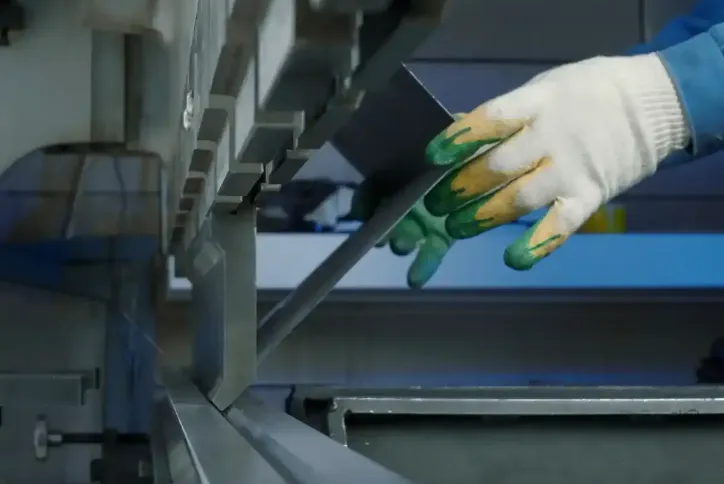
After cutting, sheet metal parts are typically formed using a press brake. This process bends flat sheet metal into the required angles and geometries specified by the design. The capabilities of the press brake and its control system directly impact part accuracy, consistency, and overall manufacturing efficiency.
Forming introduces the largest variation due to springback and material inconsistency. However, modern CNC press brakes, a key component of advanced sheet metal fabrication technology, can control this. These systems use programmable controls, precision tooling, and automated backgauges to position material accurately and produce repeatable bends. Operators can store and recall programs, reducing setup time and ensuring consistent results across production runs. Tooling libraries standardize setups and save time.
Advanced press brake technologies, such as angle measurement systems and automatic crowning, further improve accuracy by compensating for material variations and machine deflection during bending. This is particularly important for long bends, where even minor machine deflection can create angle variation across the length of the part. These features help maintain tight tolerances and reduce the need for manual adjustments or rework.
Welding, Assembly, and Inspection Complete the Accuracy Loop
Accuracy does not end after cutting and bending. Sheet metal parts often move into welding, hardware insertion, fastening, and final assembly. Each of these steps can introduce variation if the part is not fixtured correctly or if the process relies too heavily on manual positioning. Modern sheet metal fabrication technology helps control this by using digital work instructions, repeatable fixtures, controlled weld procedures, and inspection checkpoints throughout production.
Fixtures are especially important when multiple parts must be held in position for welding or assembly. A well-designed fixture controls spacing, alignment, and orientation so the finished part matches the intended geometry. This reduces distortion, improves fit-up, and limits the amount of rework needed after welding. For assemblies with tight tolerance requirements, fixture design can be just as important as the cutting or forming equipment used earlier in the process.
Inspection technology also contributes to consistency. Fabricators may use calipers, height gauges, coordinate measuring machines, laser measurement systems, or other inspection tools, depending on part complexity and tolerance requirements. These checks confirm that hole locations, bend angles, flatness, edge quality, and assembly dimensions remain within specification. When inspection data is used during production, issues can be found before they affect an entire batch.
The value of sheet metal fabrication technology is its ability to connect each step of the process. CAD files define the part, CAM programming controls cutting, CNC press brakes manage forming, fixtures support assembly, and inspection confirms the final result. When these systems are aligned, the shop can produce parts with tighter accuracy, better repeatability, and fewer surprises during installation or end use.
Work With a Team That Uses Sheet Metal Fabrication Technology to Control Quality
S&R Sheet Metal uses modern sheet metal fabrication technology to produce parts that meet the application, drawing, and production requirements. From cutting and forming to welding and assembly, the process is built around accuracy, repeatability, and reliable fit.
If you need precision sheet metal parts for a specific application, S&R Sheet Metal can help you move from design requirements to finished components. Contact S&R Sheet Metal to discuss your next fabrication project.