
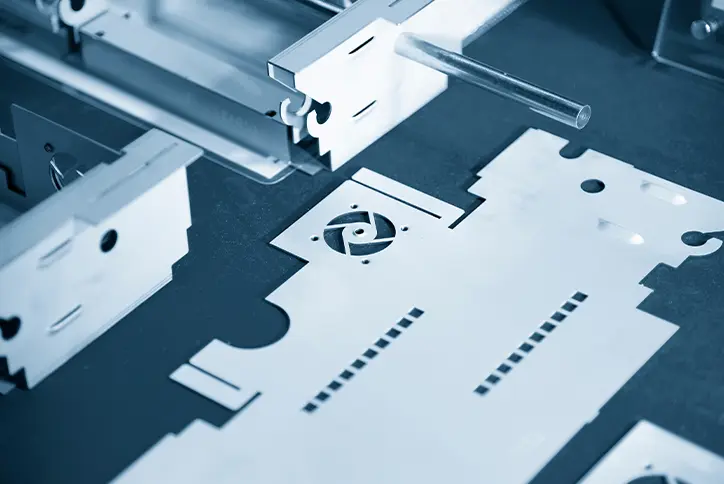
Original equipment manufacturers often rely on custom-fabricated sheet metal components when off-the-shelf components are not suitable or do not exist. OEM sheet metal fabrication delivers precise, repeatable, production-ready parts and assemblies, allowing manufacturers to bring their products to market with components that fit the application, meet performance requirements, and help the finished product stand apart from competing equipment.
What is OEM Sheet Metal Fabrication?
OEM sheet metal fabrication is the process of cutting, punching, forming, and joining flat sheet metal into components and assemblies for use in a manufacturer’s proprietary product design. The OEM generally supplies the design requirements, drawings, and specifications, while the fabricator produces the parts to match the intended application. In many cases, the fabricator may also provide practical design assistance, helping identify manufacturability issues, suggest fabrication methods, or recommend small changes that improve fit, function, or production efficiency.
OEM sheet metal fabrication can support a wide range of custom equipment components, from individual formed parts to multi-piece assemblies. Common examples include equipment panels, access doors, guards, covers, brackets, mounts, supports, enclosures, housings, trays, chutes, and welded or fastened assemblies. These components may be designed for fit, safety, service access, durability, appearance, or integration with other equipment systems.
Why OEMs Need Custom Sheet Metal Fabrication
OEMs often need custom sheet metal parts because standard components do not match the fit, function, mounting requirements, durability needs, or appearance of their equipment. Those parts may be central to the equipment’s performance, safety, serviceability, or final assembly. However, producing them in-house requires skilled labor, specialized equipment, material inventory, and fabrication knowledge that many OEMs do not want to maintain internally. Outsourcing OEM sheet metal fabrication gives manufacturers access to those capabilities while keeping internal teams focused on product design, assembly, testing, and delivery.
OEMs are facing mounting pressures to deliver products that fit specific applications, which often require custom components and assemblies. Common reasons for customization include:
- More product configurations. OEMs may need different panels, brackets, guards, covers, enclosures, or formed parts to support multiple equipment models, options, or customer requirements.
- Customer-specific equipment requirements. Custom sheet metal parts may be needed when a customer’s application, facility layout, operating environment, or equipment specification requires a nonstandard design.
- Integration with proprietary designs. OEM parts must often fit around existing equipment geometry, mounting points, moving components, access points, controls, or other assemblies.
- Design changes or product updates. New product versions, field improvements, replacement parts, and engineering changes can require updated sheet metal components that match the revised design.
- Performance, safety, and serviceability needs. Custom fabrication can support guarding, airflow, mounting, accessibility, durability, appearance, and other requirements tied to how the equipment is used and maintained.
Some OEM sheet metal fabrication may be done in-house by the manufacturers, but many choose to outsource for a variety of reasons:
- Limited internal fabrication capacity. OEMs may not have enough equipment, floor space, or available shop time to handle custom sheet metal work without slowing core production.
- Skilled labor shortages. Fabrication requires trained people who understand cutting, forming, welding, tolerances, finishing, and assembly. Outsourcing reduces the need to hire, train, and supervise those roles internally.
- Equipment investment and upkeep. Laser cutters, press brakes, punches, welding equipment, tooling, inspection tools, and related software require capital investment, maintenance, calibration, and operator training.
- Material sourcing and inventory management. A fabricator can manage sheet metal purchasing, supplier relationships, common material stock, substitutions, and storage, rather than requiring the OEM to carry that responsibility in-house.
- Material cost volatility and tariff-related purchasing complexity. OEMs may still see material changes reflected in pricing, but outsourcing keeps issues such as day-to-day metal purchasing, supplier coordination, tariff tracking, and availability with the fabricator.
- Production troubleshooting and rework control. Experienced fabricators are responsible for resolving fabrication issues, adjusting processes, and helping prevent repeat problems before parts reach the OEM’s assembly process.
- Need for faster prototypes or small production runs. Outsourcing enables OEMs to access fabrication capacity for first articles, short runs, and design iterations without disrupting internal production schedules.
- Need for practical manufacturability input. A fabricator can review whether the part can be made efficiently and suggest changes to improve fit, function, material use, forming, or assembly.
- Capacity flexibility without fixed overhead. Outsourcing lets OEMs add fabrication support when needed without carrying the ongoing cost of equipment, labor, training, maintenance, material storage, and shop space during slower periods.
- Focus on core production. Many OEMs prefer to keep internal teams focused on product design, assembly, testing, delivery, and customer support instead of managing a separate fabrication operation.
How Fabrication Supports Fit and Function
Custom sheet metal parts must fit the equipment after cutting, forming, welding, and assembly. A part that looks correct as a flat pattern or drawing can still create problems if bend angles, hole locations, material thickness, weld placement, or finished dimensions are off. Component design can influence strength, clearance, service access, vibration resistance, airflow, safety guarding, and overall durability. Small errors can affect how a guard closes, how a bracket lines up, how an enclosure fits around internal components, or how an assembly connects to the rest of the equipment.
An experienced fabricator can review the part before production and flag issues that may make it harder to manufacture or install. This may include recommending a different bend approach, splitting a large part into smaller sections, adjusting hole placement, changing material thickness, or simplifying an assembly to reduce unnecessary welding or rework. These changes can help the OEM receive parts that install correctly, perform as intended, and can be produced more consistently over future orders.
Choose S&R For OEM Sheet Metal Fabrication
As a trusted partner for OEM sheet metal fabrication, S&R provides the precision, skilled fabrication knowledge, and responsive support manufacturers need for custom equipment parts and assemblies. Our team works with OEMs to produce components that match drawings, fit the intended application, and support repeatable production. With capabilities in cutting, forming, welding, assembly, and material sourcing, S&R can help customers move from design requirements to finished sheet metal parts built for real equipment use.
Contact us when you are ready to start your custom metal fabrication project.