
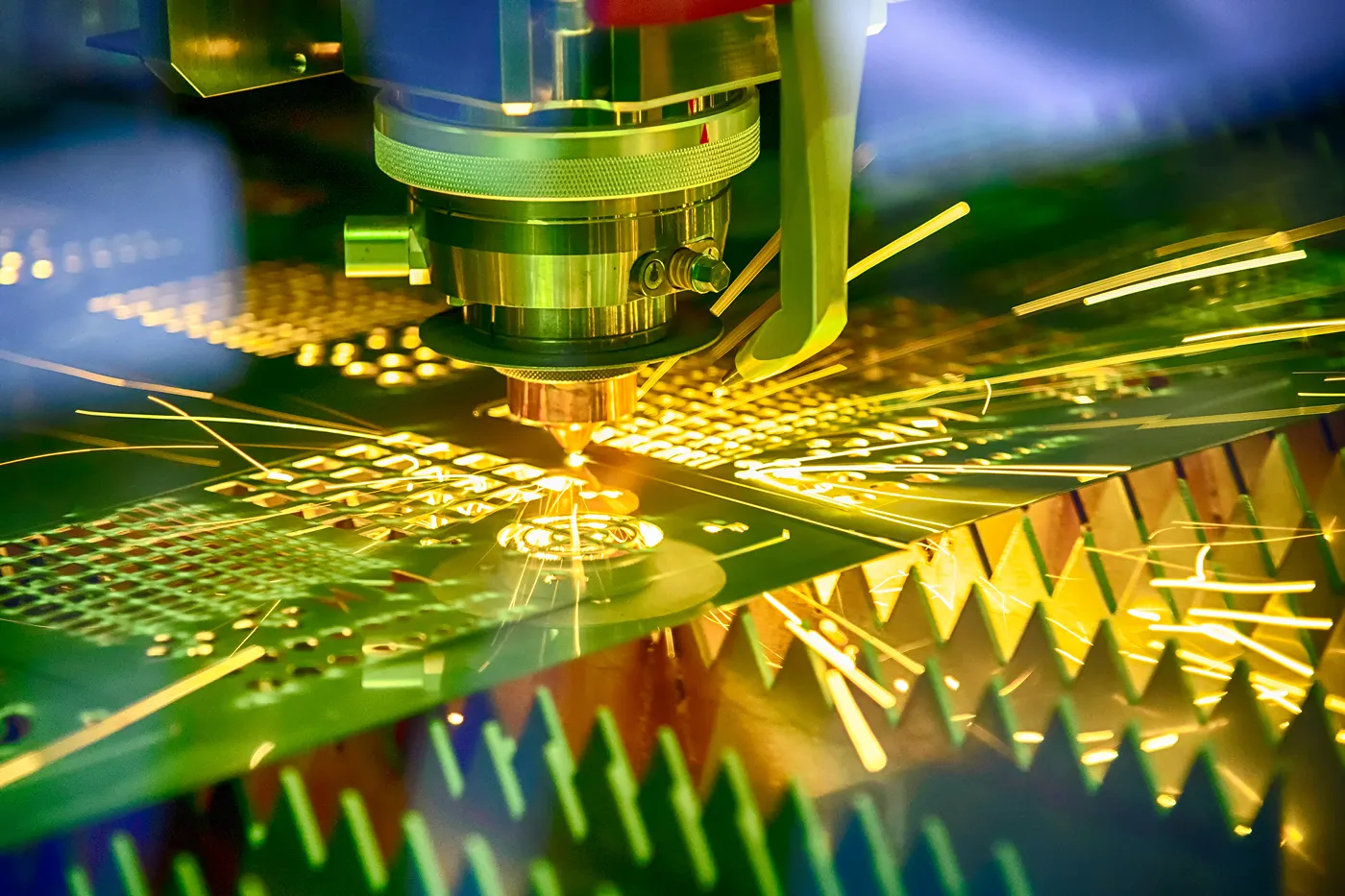
Once design and material selection are locked in for your parts, guards or assemblies, the first fabrication step is cutting flat blanks from stock. Two common methods are sheet metal laser cutting and plasma cutting.
Choosing between them depends on the application needs. A panel with closely spaced openings presents different requirements from a heavy plate component with a simple outline. Cutting also needs align with downstream processes, whether the blank will be bent, welded, or incorporated into a larger assembly.
How Laser Cutting and Plasma Cutting Differ
Sheet metal laser cutting uses a focused beam to heat the material along a programmed path, while an assist gas removes material from the cut. The narrow cut, called the kerf, allows fine contours and detailed openings. This makes laser cutting a strong candidate when the design requires small features or tightly controlled dimensions, depending on material thickness.
Plasma cutting uses an electric arc and ionized gas to melt and remove electrically conductive metal. CNC plasma systems follow programmed contours and can produce repeatable components rather than just rough blanks. Cut quality varies substantially by system, so the limits of a basic plasma cutter should not be treated as the limits of every plasma process.
Match the Cutting Process to the Project Requirements
Laser cutting generally offers a narrower kerf and finer contour capability, which can favor designs with detailed cutouts or small features. Plasma remains a candidate for thicker components whose geometry and dimensional requirements suit the available system.
Before comparing the cutting processes, identify which dimensions control fit. For example, the mounting-hole pattern on a custom guard may need tighter control than an outside edge that isn’t against another component. Where tighter tolerance and control are required should be specified in the drawing so that the fabricator doesn’t assume every dimension needs the same tolerance.
Edge condition is another consideration. An edge can meet its location requirement yet still need additional work to achieve the specified finish. While laser cutting provides a clean edge with minimal residue and scale, it may still require finishing depending on the part’s specification, material, and thickness.
For custom parts, guards, and assemblies, the following comparison provides a starting point for discussing the cutting method. These are general process differences.
| Comparison | Fiber laser cutting | CNC plasma cutting | Impact on the finished part |
|---|---|---|---|
| Kerf width of material removed | Generally narrower; supports finer contours and closely spaced features. | Generally wider; minimum feature sizes depend on the plasma system and material thickness. | A wider kerf limits how narrow slots can be and how closely openings can be spaced while retaining the metal between them. Narrower kerfs allow finer cut details; programmed compensation controls the finished profile size. |
| Heat-affected zone (HAZ) Unmelted metal altered by cutting heat | Generally smaller than with conventional plasma, but not absent | Generally larger than with fiber laser cutting | HAZ is often the weakest point in the part; hard, brittle edges are more prone to cracking during machining or welding, edges may have distortion or warping |
| Dimensional accuracy and fine detail | Generally favors small features and tighter profile requirements. | Suited to simpler profiles where fine detail and the tighter dimensional control of fiber laser cutting are not required. | Variations in hole location or profile dimensions can prevent fasteners from lining up or mating parts from fitting. Small openings may need a separate machining operation when cutting cannot meet their final dimensions. |
| Edge squareness and taper | Generally less departure from a square edge, though taper can still occur. | Generally more edge angularity than fiber laser cutting; confirm suitability where square mating edges are required. | Taper makes a hole or profile a different size at the top and bottom surfaces. Angled edges can leave uneven gaps between mating components or require machining to achieve full-face contact. |
| Edge finish and cleanup | Clean cuts with minimal residue and scale, reducing secondary finishing. Additional preparation may still be needed for some applications. | May require more edge cleanup than fiber laser cutting. Required finishing depends on the material, thickness, and specified delivery condition. | Dross and rough edges can interfere with seating against another component. Residue or scale may need removal before welding or coating; visible edges may require further finishing to meet appearance requirements. |
| Suggested uses | Detailed brackets or mounting plates with small slots and closely controlled profiles, sheet metal guard panels with detailed openings or closely spaced mounting features, and detailed sheet metal blanks that will be formed and joined into an assembly | Thicker base plates or gussets with simpler contours and compatible tolerances, thicker guard-support plates with simpler outlines, thicker plate components incorporated into a welded fabrication | The choice depends on material and thickness, smallest feature size, required tolerances, and acceptable edge condition. Fit with mating parts and the preparation needed before forming, welding, or coating also influence the choice. |
Plan Your Custom Metal Project with S&R Sheet Metal
At S&R Sheet Metal, we offer CNC fiber laser cutting and CNC plasma cutting with the ability to cut materials up to 1 inch thick. Beyond cutting, our fabrication capabilities include bending, forming, welding, and assembly, allowing us to provide completed components and products that meet your specifications
Send us your drawings or project requirements, including the material specification, quantities, and critical dimensions. Let us know whether you need cut parts or a broader fabrication scope, along with your requested completion date. We have the expertise and capabilities to deliver exceptional results that match your expectations.